

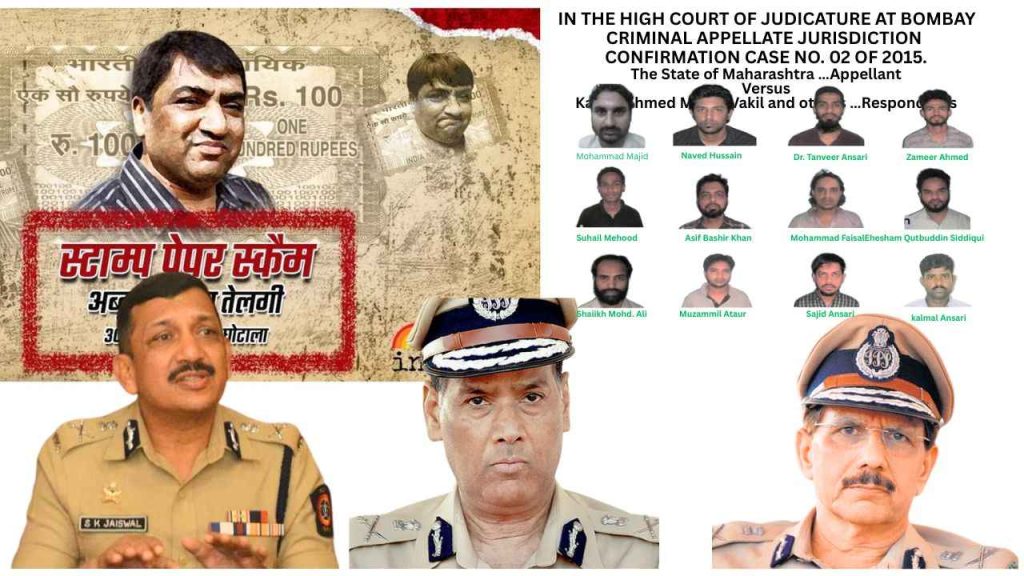
On July 11, 2006, seven coordinated bomb blasts devastated Mumbai’s local train network, killing 187 people and injuring 824 during the evening rush hour. The Anti-Terrorism Squad (ATS) Mumbai, under Chief KPS Raghuvanshi, with Additional Commissioners Jaijeet Singh (ATS Mumbai) and Subodh Kumar Jaiswal (Maharashtra ATS), and Mumbai Police Commissioner A.N. Roy, led the initial investigation, securing convictions in 2015. However, on July 21, 2025, the Bombay High Court, in Confirmation Case No. 02 of 2015, acquitted all 12 accused, citing prosecutorial failures. This 662-page judgment, particularly pages 285 to 324, sharply criticizes Subodh Kumar Jaiswal’s actions, attributing significant responsibility for the case’s collapse to his lapses. The Maharashtra ATS appealed the verdict to the Supreme Court on July 22, 2025. This analysis examines Jaiswal’s role, the court’s findings, and his prior judicial scrutiny in the Telgi scam.
Bombay High Court’s Critique of Subodh Kumar Jaiswal
The court’s judgment identifies Subodh Kumar Jaiswal, then Additional Commissioner of Police for Maharashtra ATS, as a central figure in the prosecution’s failure, detailing his lapses across pages 285 to 324. The key criticisms include:
Improper MCOCA Sanction (Para 678–679, 713–746)
The court questioned Jaiswal’s authority to approve the application of the Maharashtra Control of Organised Crime Act (MCOCA), as his role as Additional CP, Moffusil, did not cover Mumbai City, where all seven blasts occurred. The Station Diary (Exh. 2546) indicates the MCOCA proposal was submitted to ATS Mumbai but approved by Jaiswal, raising jurisdictional concerns. Specific issues include:
- Insufficient Documentation (Para 713, 717): No evidence suggests Jaiswal received or reviewed critical documents, including two chargesheets, before granting approval, indicating a failure to apply due diligence.
- Reliance on Oral Information (Para 716): Jaiswal relied on unverified telephonic information about chargesheets, neglecting to examine the documents themselves.
- Lack of Specificity (Para 718, 721): The approval order omitted key details, such as the specific “organisation” involved (e.g., SIMI) and whether MCOCA covered acts of insurgency, demonstrating a lack of understanding.
- Mechanical Approval (Para 743, 746): The court found Jaiswal’s approval was “mechanical,” merely reproducing MCOCA definitions without verifying “continuing unlawful activity” or registered offenses against accused A.13, rendering the approval invalid due to “complete non-application of mind.”
Failure to Testify (Para 759–761, 772)
Jaiswal’s absence as a witness before the magistrate was deemed critical. His testimony was necessary to validate the MCOCA approval process, especially given admissions by prosecution witness PW-174 that chargesheets were not available during the proposal submission and that relevant documents were sent to Jaiswal later without case diary entries. The prosecution’s reliance on PW-174 identifying Jaiswal’s signature was insufficient to prove the approval’s contents, further weakening the case.
These lapses, described as a lack of due diligence and non-application of mind, significantly undermined the prosecution, contributing to the acquittal of all accused.
Broader Context of the Acquittals
The Bombay High Court’s decision to acquit the 12 accused, previously convicted in 2015 (five sentenced to death, seven to life imprisonment), was based on broader prosecutorial failures, including unreliable witness testimonies, invalid identification parades, and confessions allegedly obtained through torture. The judgment, delivered after 19 years of incarceration, sparked public outrage and prompted the Maharashtra ATS to appeal to the Supreme Court, with a hearing scheduled for July 24, 2025. Jaiswal’s actions, as detailed in the judgment, were pivotal in the case’s collapse, highlighting systemic issues in the investigation.
Subodh Kumar Jaiswal’s Prior Record: The Telgi Scam
This is not the first instance of judicial criticism against Jaiswal. In the Telgi fake stamp paper scam, a Special Investigation Team (SIT) was formed on November 2, 2002, via Resolution Number CII 07/2002/389/POL-12, with Jaiswal, then Deputy Inspector General of SRPF, Mumbai, as its head. The Special MCOCA Court, Pune, in Case No. 02/2003, issued strictures against him in paragraphs 50 and 60, alleging he aided the prime accused, Abdul Karim Telgi. This matter remains pending before the Bombay High Court (WP/2486 of 2007). Despite these allegations, Jaiswal secured high-profile roles, including Commissioner of Police, Mumbai, Director General of Police, Maharashtra, and Director of the Central Bureau of Investigation (CBI), raising questions about accountability and oversight.
Implications and Accountability
The Bombay High Court’s findings underscore Subodh Kumar Jaiswal’s significant role in the failure of the 2006 Mumbai train bombings prosecution. His improper MCOCA sanction and failure to testify, combined with prior allegations in the Telgi scam, suggest a pattern of judicial concerns. The acquittals highlight the critical need for procedural rigor in high-stakes cases, with Jaiswal’s actions serving as a focal point for accountability discussions. The ongoing Supreme Court appeal will further determine the case’s legacy and its implications for India’s law enforcement practices.
Accountability Demanded in Mumbai Train Blasts Acquittals
The recent acquittal of all 12 accused in the 2006 Mumbai train bombings, despite 187 deaths and 824 injuries, has ignited a fierce debate about accountability within the Maharashtra police force and legal system. While the Bombay High Court’s judgment heavily implicates Subodh Kumar Jaiswal for his “non-application of mind” and procedural failures in the MCOCA sanction process, particularly his absence as a witness, questions are now being raised about others involved.
Concerns are mounting regarding the roles of then Commissioner of Police Shri A.N. Roy, ATS Chief KPS Raghuvanshi, and the entire legal team. Were they unaware of the fundamental procedures for MCOCA sanction approvals? Did they not possess the authority to compel Mr. Jaiswal’s appearance as a crucial witness in court?
Critics argue that the responsibility for the acquittals extends beyond the accused. They contend that Subodh Kumar Jaiswal, A.N. Roy, KP Raghuvanshi, and the entire legal team are collectively accountable for the devastating outcome of the case. The public is now demanding that these “organized officers” be held to account, with calls for swift and stern action to ensure justice is served for the victims of the 2006 Mumbai train bombings.


